


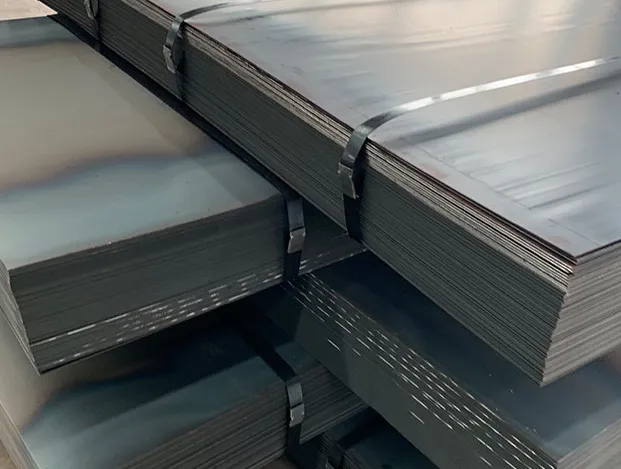


FH32 shipbuilding steel plate Chemical Composition %
|
|
|
|
N |
|||||||||
|
FH32 |
0.16 |
0.50 |
0.90-1.60 |
0.025 |
0.025 |
0.015 |
0.02 |
0.35 |
0.20 |
0.80 |
0.08 |
0.009 |
0.40%. If the delivery condition is TMPC, the CE will be : ≤ 0.36% (thickness ≤ 50mm),≤0.38%( when the thickness >50-100). Ceq% =(C+Mn)/6+(Cr+Mo+V)/5+(Ni+Cu)/15.
FH32 shipbuilding steel plate Mechanical Property
|
|
||||||||||
|
FH32 |
440-570 |
315 |
22 |
E.T ℃ |
||||||
|
-60 |
50 |
>50-70 |
>70-100 |
|||||||
|
L |
C |
L |
C |
L |
C |
|||||
|
31 |
22 |
- |
- |
- |
- |
|||||
1. What are the key mechanical properties of ABS Grade FH32 shipbuilding steel plate, and how do they differ from lower grades?
ABS Grade FH32 is a high-strength, fine-grained steel with a minimum yield strength of 315 MPa47 J at -60℃ (-76℃F). This distinguishes it from lower grades like AH32 (315 MPa yield, but impact tested at 0℃) and DH32 (impact tested at -20℃). The "-60℃" requirement makes FH32 suitable for vessels operating in extremely cold environments, such as Arctic waters, where brittle fracture risks are high.
2. What chemical elements are critical to achieving FH32's low-temperature toughness, and why?
: <=0.16% to minimize brittleness and improve weldability.
: 0.90-1.60% to enhance strength and hardenability.
: >=0.015% as a deoxidizer to refine grain structure, a key factor in low-temperature toughness.
: Combined <=0.10% to further refine grains and improve strength-toughness balance.
: <=0.025% each to reduce impurities that could degrade impact resistance.
3. What are the primary applications of ABS Grade FH32 in shipbuilding?
Hull structures of icebreakers and ice-strengthened cargo ships.
Offshore platforms and support vessels in cold climates, such as those in the Barents Sea or Canadian Arctic.
Critical components of LNG carriers, where low temperatures and high structural loads coexist.
Subsea pipelines and equipment exposed to extreme cold and dynamic stresses.
4. How is ABS Grade FH32 manufactured to ensure compliance with ABS standards?
: Use of electric arc furnace (EAF) or basic oxygen furnace (BOF) with ladle refining to minimize impurities.
: Hot rolling at 850-950℃ to achieve precise grain refinement, enhancing toughness.
: Normalizing (heating to 870-910℃, air-cooling) or thermo-mechanical control processing (TMCP) to ensure uniform microstructure and mechanical properties.
: Mandatory Charpy V-notch impact tests at -60℃, ultrasonic testing for internal defects, and tensile testing to verify yield and tensile strength.
5. What welding considerations are specific to ABS Grade FH32?
: 80-120℃ for plates >=20 mm thick to prevent cold cracking.
Low-Hydrogen Consumables: Use of E7016 or E7018 electrodes to minimize hydrogen-induced cracking.
: Keep heat input between 1.5-3.0 kJ/mm to avoid overheating the heat-affected zone (HAZ), which could reduce toughness.
Post-Weld Heat Treatment (PWHT): Optional for stress relief but not typically required, as FH32's fine-grained structure resists embrittlement.
Priljubljena oznake: abs grade fh32 shipbuilding steel plate, China abs grade fh32 shipbuilding steel plate manufacturers, suppliers, factory


